
How are your New Years’ resolutions going, my beautiful slugs? They say it takes 21 days to build a habit, but did you know that was based on no research at all, and actually comes from a plastic surgeon’s 1960 self-help book that used self-guided missile systems as a metaphor for human behavior??1
When researchers actually tested this in 2009, their results were all over the place — 66 days was the average (so if you made a resolution, that would be about now), but some people took up to 254 days!
Complexity is a huge factor, too — a study in 2023 suggested that ‘developing a handwashing habit takes weeks, while developing a gym habit takes months,’ because going to the gym everyday is a much more complicated set of actions.
Speaking of self-help mythology, there’s something else floating around the internet that we must address: the idea that people with ADHD cannot form habits at all.2
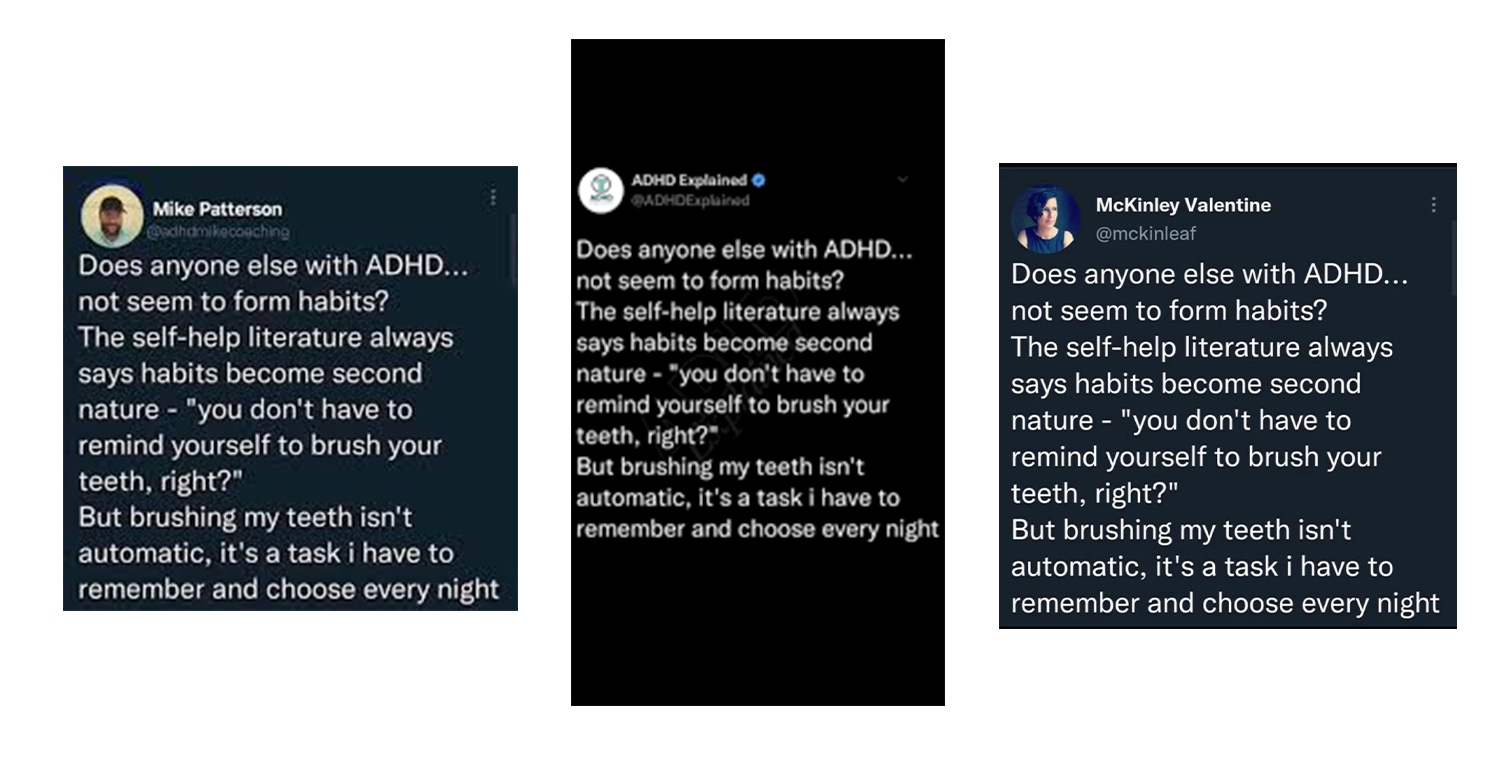
Based on vibes alone, I am inclined to agree — I can’t seem to make an exercise routine stick, or keep a journal, or regularly vacuum my floors. But my critical brain doesn’t really buy it.
When people say this, their examples are usually chores and self-care, but habits are way more than that. They’re automatic behaviors triggered by an environmental cue, like how I always reach for a seatbelt when I sit in a car, or put my phone in my back right pocket when I’m walking around the grocery store.
ADHDers do stuff like this all the time, and when you look into the research, there’s actually some evidence that we are more habitual in our behavior.
ADHD and ‘habit-forming illnesses’ like addiction and OCD often go together — both of which have been framed by researchers as an over-reliance on the brain’s habit-learning system. And a 2019 study on children with ADHD found that they responded more habitually on a computer task than other kids.
Cognitive neuroscientists at Trinity College Dublin have theorized a ‘dual system perspective’ on habits, which might explain what’s happening here:
“This dual system account conceptualizes habits as resulting from learned [stimulus-response] associations, which can be modulated by goal-directed control… when sufficient attention and cognitive resources are available.”
So, you learn automatic behaviors through cues and rewards, but you can override these behaviors with enough brain energy and executive functioning skills.
If you accept that ADHD comes with higher rates of addiction — the extreme end of habit formation, according to the neuroscientist Marc Lewis — then clearly habits are possible. You can’t form “bad” habits without the ability to form “good” habits, since both involve the same cognitive learning process.
But, if you need to use executive control to break habits, then the EF challenges of ADHD would make that harder. And, since you need executive control to make a habit, too, that would also be harder! It’s a conundrum: we may rely more on automatic behavior, and be less able to steer the formation of it.
One mistake I think people are making when they argue we cannot form habits at all is mixing up automatic behavior with consistent behavior. Researchers have found that consistency is the main thing that makes a habit stick, but remember the high end of habit formation they found, 254 days?
That’s eight months! Some of us need to do a behavior consistently for a really long time before it becomes automatic, but consistency is a huge challenge when you’re constantly getting whipped around by your interests and forgetting stuff!
Memory plays a huge role — people with better prospective memory (the kind you use when you plan to do something in the future and then actually remember to do it) have been found to form stronger habits more quickly.
Habits are also context-dependent; they ‘need a time and a space,’ Marco Stojanovic and colleagues write in a 2022 study, which found students who constantly switched up their study locations and times were worse at forming a habit.
So, if you’re a novelty-seeker who changes up your environment a lot: going to new places, switching jobs, throwing your entire life in the dumpster and leaving the country like I did a few times… you’re also chronically disrupting all your habits.
You might just need to use different methods to form habits, too. The philosopher Polaris Koi writes that self-control is commonly thought of as internal willpower, but there are also situational strategies that get overlooked.
Using internal willpower might look like deciding to quit drinking, going to a bar, and ordering a soda, but a situational strategy would just be avoiding bars altogether. Instead of trying to white-knuckle through temptation on your own mental strength, you use the environment as a scaffold to support habit formation.
These situational strategies, according to Koi, are the kind that ADHDers need, since executive dysfunction makes internal willpower more of a struggle. But, since the world is built on the assumption that self-control equals internal willpower full-stop, we are essentially set up for failure:
“..their different neurobiology may not make certain self-control practices, such as ‘willpower’ strategies, impossible—it merely makes them excessively effortful and difficult. As a result, one may hold on to the hope that with time, as one patiently flexes one’s ‘mental muscle’, these difficult practices would become easier. However, knowledge of a fuller array of effective self-control behaviours would better enable these agents to seek out a ‘toolkit’ of means to self-control that do not entail disproportionate difficulty.”
Koi also points out a material ‘double bind’ — the fact that low socioeconomic status is correlated with ADHD, meaning that a lot of ADHDers likely do not have the financial means to change their environments in ways that allow them to access to the self-control strategies they need to thrive.
If you can’t afford to switch jobs, if you can’t afford a smartwatch and app subscriptions, if you have unstable housing and lack social support, you’re stuck falling back on internal willpower strategies that likely do not work well for you, making conscious habit formation feel impossible.
For Koi, self-control is an access issue, and if his theory is true:
“..then individual differences in self-control are not merely a matter of inherent character: they are a matter of justice. By emphasizing intramental self-control behaviours over environmental ones, present discourse on self-control obscures the availability and efficacy of environmental self-control strategies, setting people with disorders such as ADHD at a disadvantage.”
One of the most popular situational strategies is something neurodivergent people have already figured out on their own: body doubling, which builds social accountability and motivation into the environment.
There’s also visual cues, like post-it notes, or keeping a work-in-progress out on the table so you’re reminded to finish it.3 And the oft-cited ‘point of performance’ advice, where you keep whatever you need for a habit within reach.
I keep my meds next to the coffee station, which consistently reminds me to take them every morning, since I have a severe addiction to caffeine. But on vacation, when they were in a plastic bag in my backpack in a hotel room in another time zone, my morning habit fell apart — I kept going oh shit at 2pm when I finally realized I’d forgotten to take my meds.
I don’t think that’s my brain being neurologically unable to form a habit, though. It’s just the context-dependent nature of habits in general. We are creatures of place, and our behaviors are tied to it.
His name was Marshall Maltz, and he was talking about habituation, not habit formation. He said it took 21 days for a person to get used to their new face after surgery, but somewhere in the self-help washing machine, that felted into ‘21 days to form a habit’. Not the same thing though!! His book, Psycho-Cybernetics, was based on Cybernetics by Norbert Weiner, who studied self-guided missile systems during WWII. Maltz took Mailer’s work and applied it to people, believing that self-image was key to accomplishing goals, and if you visualized a target and ‘locked on’ then your whole body would follow suit automatically and go for it. Not sure I believe people are like missiles, or that this is the metaphor I would choose to help people improve themselves, but it’s wild how war has shaped so many of the ideas around us that we don’t even realize.
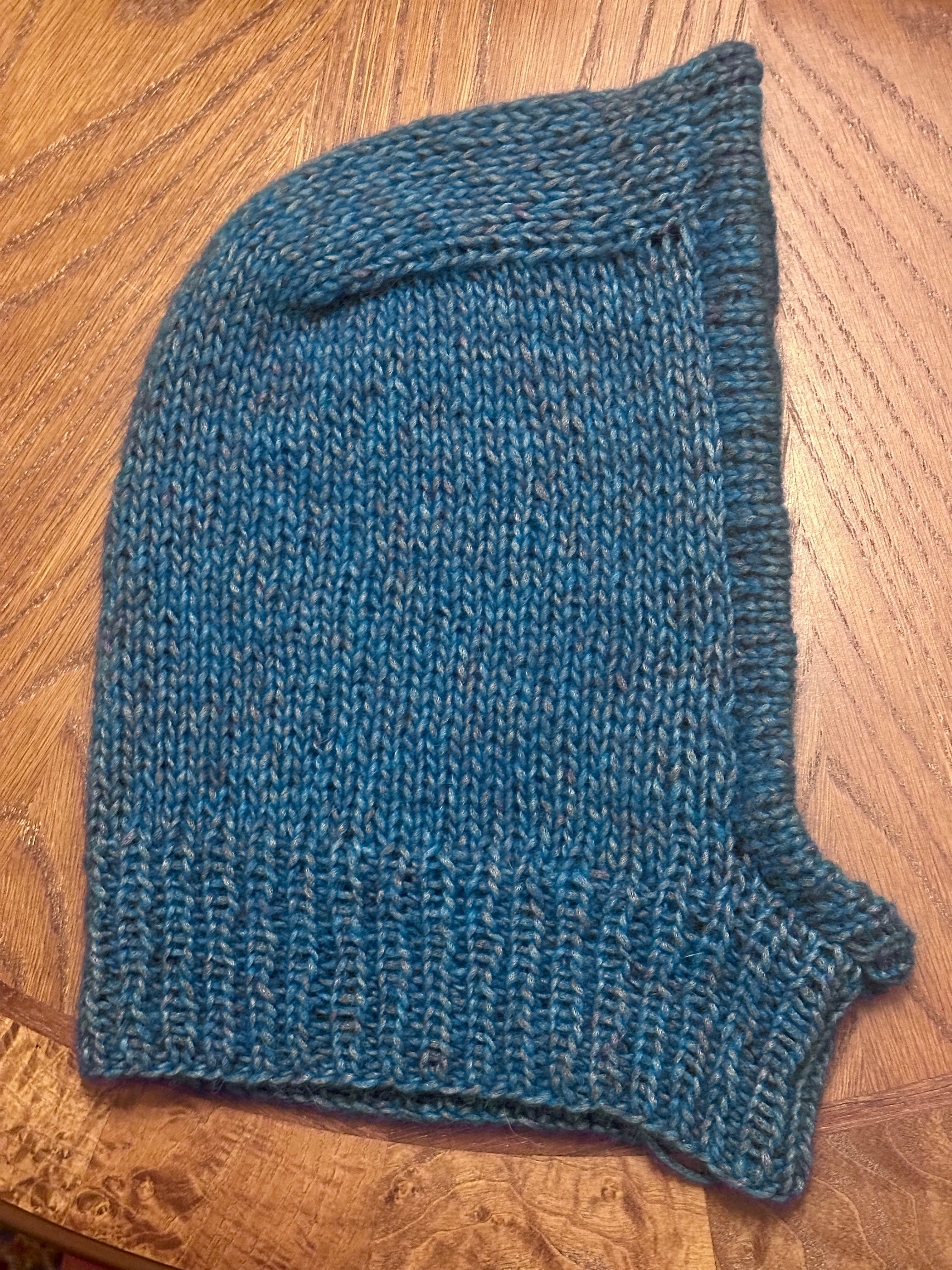
the only way I’ve managed to get any knitting projects done is just keeping them next to where I sit on the couch everyday, so I sit down and go, oh look! my knitting! let me do a couple rows! and then I do that multiple times a day and then eventually I have a balaclava, and a knitting habit.
This is sweet and constructive. Thank you. And I still read "balaclava" as "baclava" all these years later & so when I read your last line I said "oh yay!" :-D
Thank you. This made me feel a lot less insane/ like a failure!