
I did a ton of research for my last piece on the fear of the disability con and Uta Frith’s claim that masking has ‘no scientific basis’. Because I am highly motivated by annoyance and that claim very much annoys me, I had to do a full review of every published paper that even so much as mentions autistic masking since 1991!
But of course, including all that made the piece like 6,000 words, and nobody is going to read that, so consider this a follow-up extra very special themed research round-up for paid subscribers.
The study of masking officially began in 2017, but there’s a bit of prologue going that we must cover before we get to that.
The 1990’s
The first mention I found of camouflaging behaviors was actually in a book edited by Uta Frith in 1991. Christopher Gillberg wrote a series of case studies, one of which was about a girl with Asperger’s, and he wrote that ‘symptoms of impairment of social interaction might be less conspicuous than corresponding symptoms in boys.’
A year later, Gillberg and Svenny Kopp followed up with six case studies of girls who were diagnosed later in their childhood. They wrote:
“..the type of social impairment shown by these girls tended more towards ‘clinging’ to other people, imitating their speech and movements without a deeper understanding of the silent laws of ordinary social interaction..”
Kopp and Gillberg hypothesized that girls were not being diagnosed as early or as often as boys because they were not as ‘aggressive’ and could imitate others convincingly. AKA: they were quieter and less disruptive, as girls are supposed to be, so no one noticed they were struggling.
Two autistic memoirs in the late 90’s described what Kopp and Gillberg were observing — Wenn Lawson’s Life Behind Glass, and Liane Holliday Wiley’s Pretending to Be Normal. Lawson wrote about copying others, and crashing from the exhaustion of having to keep up ‘the performance’:
“The good news is that I too have learnt to ‘blend in’ and much of the time you would not notice me or give me a second glance.”
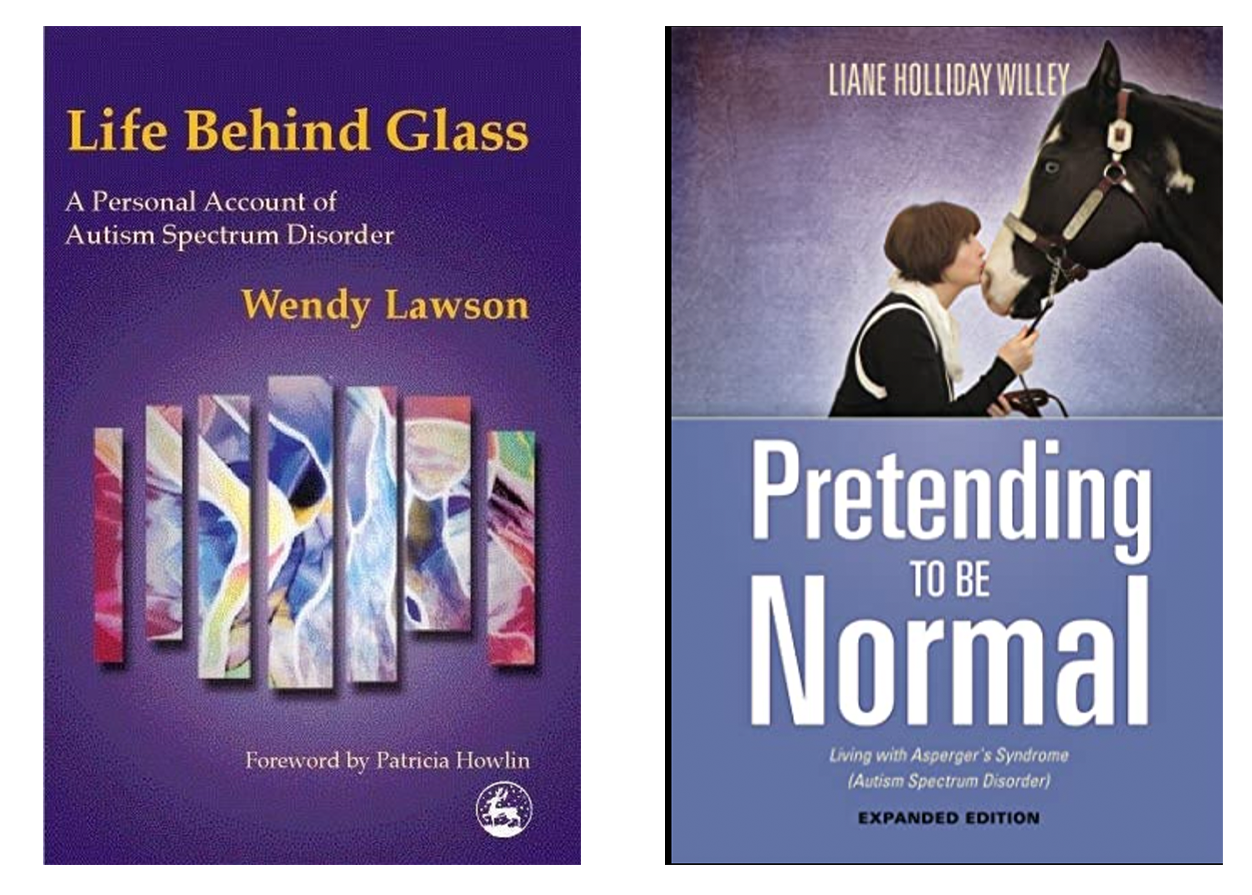
Similarly, Wiley described herself as a skilled mimic from a very young age:
“My mother tells me I was very good at capturing the essence and persona of people. At times, I literally copied someone’s look and their actions…”
“..I was uncanny in my ability to copy accents, vocal inflections, facial expressions, hand movements, gaits, and tiny gestures. It was as if I became the person I was emulating.”
Neither used the terms masking or camouflaging, although it’s clear this is what they were describing.
