
Personally, I find much motivation to write in the fire of annoyance.1 Take, for example, this annoying personal essay in The Free Press by one Christina Buttons:
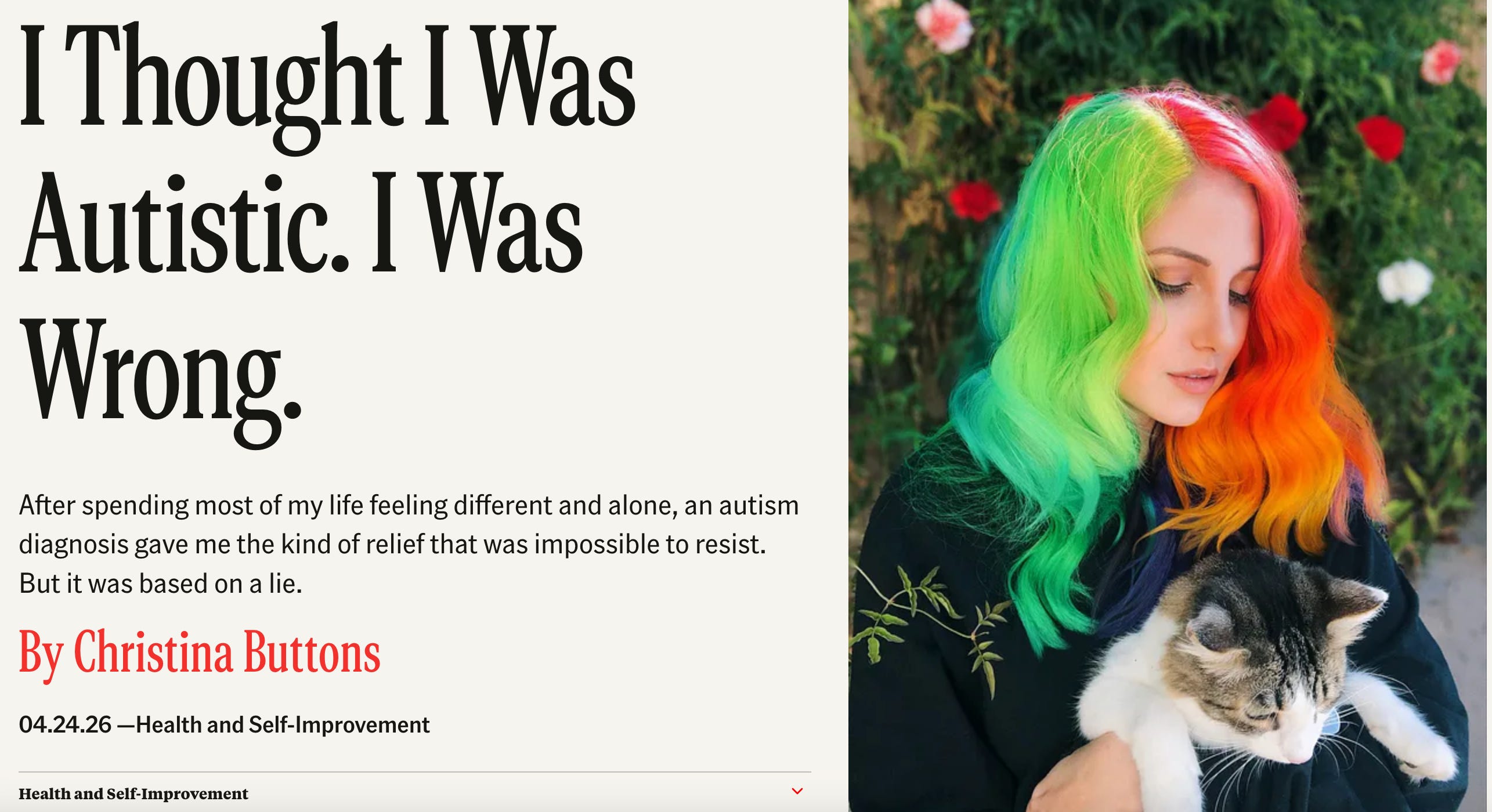
‘Tis not just your typical self-diagnosis skepticism, of which we have seen much in recent times — nay, Ms. Buttons was professionally diagnosed as an adult, and found in it quite a plausible explanation for a litany of childhood troubles:
“My monotonous voice, flat emotional expression, lack of eye contact, and failure to respond to humor—all of which were noted in psychological testing I endured as a teenager — seemed to confirm it. My all-consuming fixations on things like sharks and parasites became autistic special interests. My habit of overcomplicating basic tasks became executive dysfunction, my clumsiness a gross motor impairment, and my fidgeting “stimming.” Even my food intolerances and obsessive-compulsive tendencies seemed to fit the pattern.
But the clearest sign was in my daily war against bright lights and loud noises, which finally seemed to have a real name: sensory processing sensitivity. Suddenly, every aspect of my life, every little inadequacy or abnormality that had once tormented me, had a medical explanation.”
These are, my dearest sluggy reader,2 all textbook autistic traits. What’s more, Buttons has also said she was placed in a special education program in school, which means she was formally recognized from a young age by professionals in both education and medicine, so: why doesn’t she believe in her diagnosis now?
In 2022, Ms. Buttons started working as an ‘investigative reporter’, mostly ‘investigating’ detransition for Ben Shapiro’s conservative propaganda rag:
“I soon began taking on stories that required heavy reporting. As I spoke with sources, built rapport, asked sensitive questions, and earned their trust, I realized something that should have been obvious much earlier: I do not have a social communication deficit. Not only was I competent at socializing, I was good at it, and I improved the more I did it.”
A smoking gun this surely is not — journalism can be a friendly career for the observant autist who takes great notes. Interviewing is a highly scripted and structured social interaction, and gaining a source’s trust doesn’t require sparkling charisma, so much as quality time and keen listening.3
Ms. Buttons’ life narrative is hers to craft of course, but she is wrong to suggest that her personal story is happening at scale, especially when there’s a curious lack of engagement with the literature on masking.
Research has shown autistic women like Ms. Buttons can be quite competent at performing social skills — struggles in childhood can lead to learned compensation, particularly motivated by the desire to connect, albeit with severe mental health consequences.
In addition to the academic work, numerous books have been written on this phenomenon in recent years. Ms. Buttons’ personal story reflects this pattern, and her omission of this research is a major weakness in her writing that, frankly, doesn’t inspire confidence in her investigative journalism skills!
But of course, this is no mere personal essay, and Buttons is no random journalist — she writes for a major right-wing think tank called the Manhattan Institute, which means this is really a policy argument gussied up by lived experience. The piece is a model of the broader, ongoing culture war about who counts as autistic, and I think her conclusion tells us something important about the politics at play.
