
Since I refuse to pay Fredrik deBoer money to be mean to me, I have been waiting for his latest book All In Your Head to hit my library app. And this week, oh boy, I got the notification. It is time. Strap in, sluggies. The 2026 hate-read is upon us!!
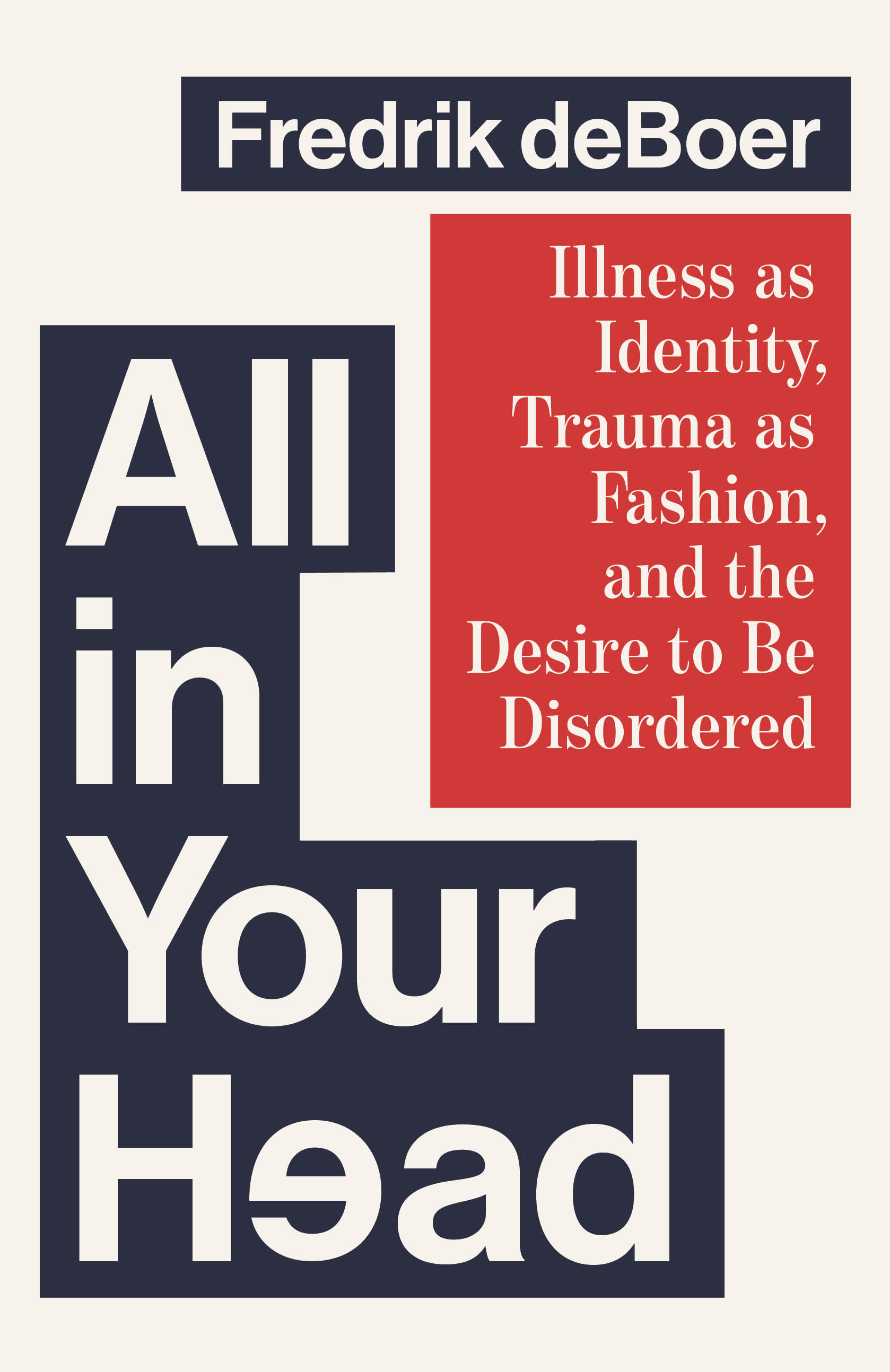
All In Your Head argues that young people on the internet, in their unquenchable thirst for attention, have turned mental illness into a status marker, which is bad for people who actually have severe mental illness, because it creates a society where we tip-toe around serious disability out of respect for each other’s identities instead of treating it the way it needs to be treated, which DeBoer believes is with more involuntary hospitalization and medical gatekeeping.
He also believes that social media apps should hide content about mental illness from children’s feeds to prevent social contagion. At the center of his argument is, of course, ADHD and autism, which he argues have been ‘gentrified’:
“This is the gentrification of disability in its purest form: the most affluent, educated, and well connected among those with a given disorder using that status to define the disorder in the public mind.”
Is that really an accurate way to describe what has happened to diagnoses like autism and ADHD? Maybe — my boys Karl and Freidrich did say ‘the ideas of the ruling class are in every epoch the ruling ideas’ — but as DeBoer seems quite unfamiliar with the actual history of both diagnoses, he ends up setting his sights on the wrong villain.
Neurodivergent Activists Made of Straw
There are many things that Mr. DeBoer writes which fall into the category of hate-reading for me, so perhaps I should begin with the things we agree on.
People with high support needs and/or intellectual disabilities (‘profound autism’, as some like to call it), do get spoken over by those of us who are verbally fluent, and they are not represented in autism research. This is a big problem, because the knowledge produced about autism through that research gets generalized to groups it does not actually apply to.1
Calling autism and ADHD ‘superpowers’ is a neoliberal rebrand that sugar-coats these conditions’ challenges, serves the interests of capitalists who want to exploit us for profit, and could threaten our claims to accommodations.2
Healthcare has been turned into a service industry, which means doctors are stretched thin, again in the interest of profit.3
All of this is bad, and for what it’s worth, all of it has been critiqued from within the neurodiversity movement for years already,4 so DeBoer isn’t telling us anything we haven’t argued about amongst ourselves before.5
Where we disagree is that I don’t think any of it is really the fault of attention-hungry neurodivergent content creators. I see all of these as market problems, structure problems, austerity problems, not personal ones. What’s more, I think DeBoer creates an irrational, angry caricature of the neurodivergent activist to argue his point, one that doesn’t reflect the more nuanced view I have of the community, which contains multitudes.6
One of his favorite examples of ‘the gentrification of disability’ is something that happened at Harvard in 2022. Students circulated a Change.org petition to protest a panel discussion on autism. Here’s how he describes it:
“An event from 2022, not widely publicized, perfectly reflects the dynamic I’m lamenting. It seems a panel of experts was slated to speak on the subject of how best to help those with autism, at a conference at Harvard University, the symbolic pinnacle of American status culture. But as the panel planned to consider treatment, disability activists shut it down. They argued that talk of treating autism suggests that the disorder is a hindrance to be managed—that is, after all, what a disability is, a hindrance—and decried the event as ‘violently ableist.’ At perhaps the most elite and celebrated academic institution in the country, one filled with people who have excelled in competitive academic performance, the idea of treating the most debilitated autistic patients was forbidden.”
There are a couple of things DeBoer gets wrong here. First, it was publicized, in the conservative press, and by him, on his Substack.
Second, it was at the Sadhguru Center for a Conscious Planet at Beth Israel Deaconess Medical Center, one of Harvard’s 15 affiliated teaching hospitals, which is in fact not at Harvard University, but 3 miles away.7
Third, they did not ask for it to be shut down, but for Harvard to publicly pull its support for the event.
And fourth, the students were not just frothing at the bit about treatment in general — they were mad that there were no autistic people on the panel, and particularly pissed about the kind of treatment advocated by one panelist, Marcia Hinds, a former ABA therapist who wrote a book called I Know You’re In There: Winning Our War Against Autism. DeBoer also leaves out the fact that Hinds actually agreed with them that an autistic person should be included on the panel.
Hinds believes autism is an immune disorder, and once you lower your kid’s brain inflammation, you can then teach them to be normal by rewarding them with Skittles when they do what you want.8 This is interesting, because DeBoer spends a chunk of the book discussing the autism mom and academic Amy Lutz’s concept of the ‘intact mind’, which is the idea that there is a normal child inside the autistic’s body, and we just need to figure out how to get in there and free them.
I’ve read Lutz’s book, and I actually agree with her that we should accept the intellectually disabled and non-speaking as they are, instead of trying to, like, find their telepathic powers or whatever. And you know, I think Jim Sinclair, the autistic self-advocate who said Don’t Mourn For Us, probably would agree, too — as they said, “There’s no normal child hidden behind the autism.”
We should probably all be against Hinds’ crusade to rescue the mythical intact mind from inside the autistic body, but DeBoer, in his infinite bitterness, seems intent on driving a wedge between us instead — a wedge shaped like ‘profound autism.’
So, he goes on:
“I cannot comprehend the arrogance of the students who led the charge against the panel at Harvard, who, from their perch at the most exclusive university in the world, declared on behalf of the entire autistic community what autism is and means. It’s unsurprising that they were disdainful of the need for treatment, given that they were so high-functioning that they flourished at an Ivy League university. These student activists do not know what it’s like to be debilitated by autism and thus have no right to speak for the entire community, which includes families and caregivers as well as patients. Those students will likely never care for someone whose autism has devastated them, robbed them of their ability to have conventional human relationships, to have a career, to be in love. Such debilitated people and their families will never have the cultural influence of self-promoting Harvard students, so they’re simply read out of the conversation.”
Quite a bit to unpack here, so allow me a few paragraphs. He makes a lot of assumptions — many of us high-functionings do know what it’s like to care for someone who has it worse than us, because autism runs in families, and autism is estimated to occur in the sibling of an autistic person ten times more than those without autism.
He also has no idea if they were really ‘flourishing’ — a quick Google unearths a 2021 article in the Harvard Political Review, where the organizer of the protest says they had to take a gap year because they were struggling so much at school.
What DeBoer is really describing in this book, though, is something that autistics like to call ‘Aspie supremacy’, and it is, again, a well-known intracommunity critique. The term is usually credited to the late autistic activist Mel Baggs, and it generally describes an attitude where some autistic people are valued more highly than others due to their abilities.
DeBoer refers to ‘the most visible and verbally coherent’ as ‘the autistic elite’, and insists that this group unjustly claims to speak for all autistics, which I found curious, as an avid reader of autistic memoir, because I am so often annoyed at how much autistic writers feel the need to carefully disclaim that they’re not speaking for everyone, partly (I assume) for fear of being accused of Aspie supremacy.
Just grabbing one off my shelf, here’s the first line in Sarah Kurchak’s memoir:
“So…
I do not speak for all autistic people. I will not try to. I do not want to. I wish to be a voice/face of autism in a much greater, more nuanced and diverse conversation, not the voice or face of autism.”
Here’s Katherine May, in her author’s note for The Electricity of Every Living Thing:
“There is no single, defining version of autism, but instead an overlapping multiplicity of minds. The term ‘spectrum’ is a poor way of capturing the sheer diversity of our experience - it’s too linear, too fixed. When I imagine us, I think of a constellation instead, or perhaps a galaxy: millions of different stars shining, each expressing their fire in a different way. I am just one way of living that experience. If you want to learn about autism, read as many perspectives as you can, and get ready to put aside all your preconceptions.”
Here’s Eric Garcia, in the introduction to his book We’re Not Broken:
“A tenet of journalism is that the writer is not the story, and I know that my story alone is not indicative of the story of autism in America writ large.”
I could go on, but you get it. This sentiment is actually so prevalent in autistic life-writing that it has become a cliche, embodied in the oft-repeated phrase: “if you’ve met one autistic person, you’ve met one autistic person.”
But perhaps the most important line in the above paragraph is the last one:
“Such debilitated people and their families will never have the cultural influence of self-promoting Harvard students, so they’re simply read out of the conversation.”
This is not historically accurate in the slightest, and it doesn’t reflect current events either.
A Brief History of Autism Advocacy
The earliest autism advocacy organizations were started by white professionals with autistic children, beginning with the National Society for Autistic Children in 1965.
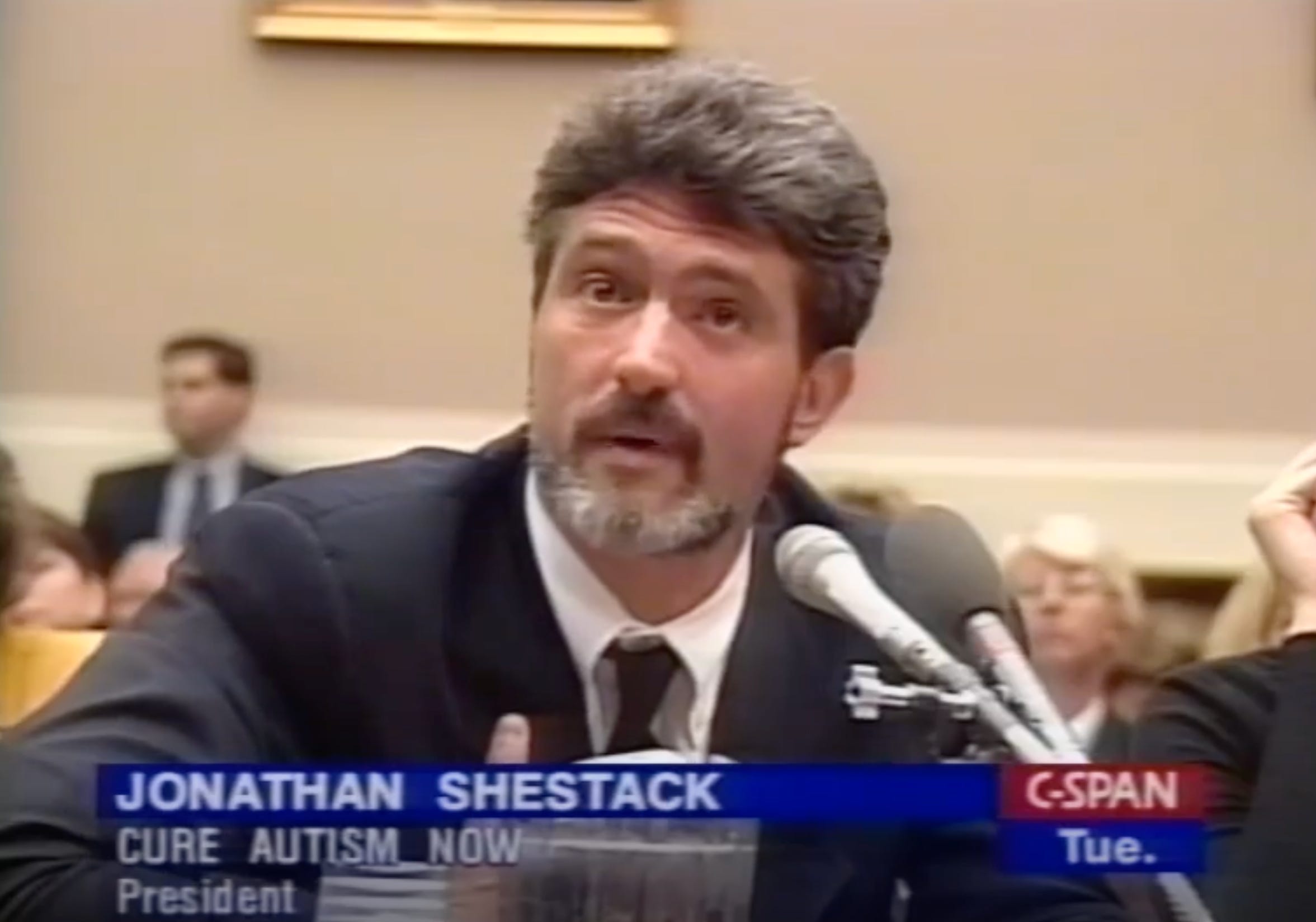
Cure Autism Now was founded in 1995 by Jonathan Shestack, a successful movie producer, and his wife, Portia Iverson, an Emmy-award winning art director, after their son Dov was diagnosed. They funded the organization with donations from their Hollywood connections, and Shestack went on to lobby Congress to pass the Combating Autism Act in 2006.9
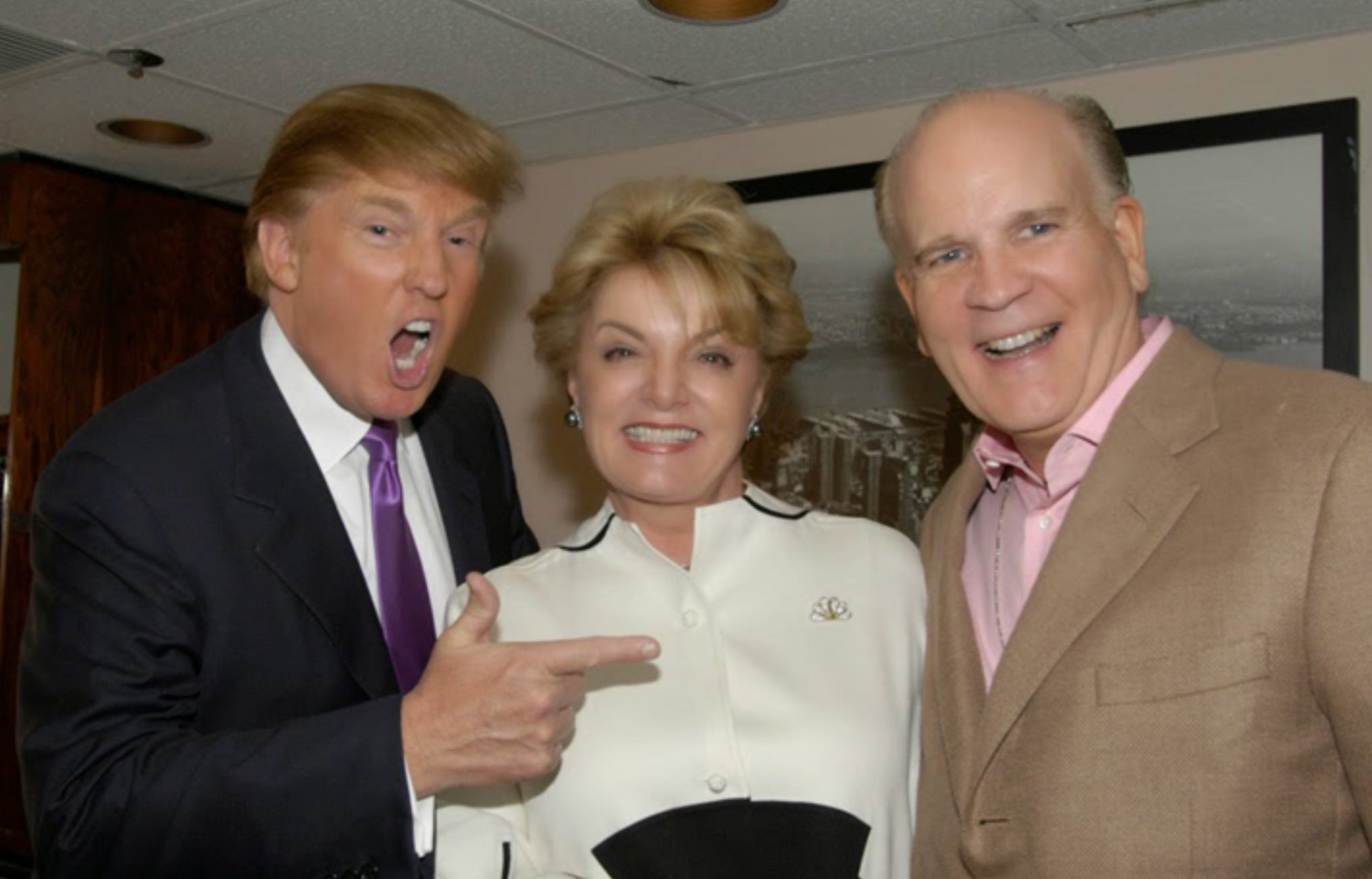
CAN was eventually folded into the big daddy of autism advocacy, Autism Speaks, which was founded by the CEO of NBC Universal and his wife, Bob and Suzanne Wright, for their autistic grandson. They got started with a $25 million donation from the CEO of Home Depot, and support from all kinds of wealthy donors, including but not limited to, Donald Trump.
One of the largest private funders of biological autism research in the world, The Simons Foundation, was founded by hedge fund manager and billionaire Jim Simons. And The National Council on Severe Autism, a relatively recent organization that picked All In Your Head for their book club this month, is also run by white affluent parents, among them Alison Singer, former VP of programming at NBC, and Jill Escher, a real estate investor.
We can also look at the Interagency Autism Coordination Committee, which advises the Department of Health and Human Services on where to allocate funding. This year, RFK Jr. replaced everyone on the committee, stacking it with parents who believe autism is caused by vaccines, and dropping the number of autistic self-advocates from seven to three (the minimum legal requirement).
Dena Gassner, an autistic researcher with an autistic son and a former member of the committee, said:
“I’m concerned that the vast majority of the autistic population, people who internalize their features of autism, which we now believe to be between 60 and 70 percent, have minimal representation at that table. I 100 percent agree that people with the highest support needs, people whose autism is externalized and notable and measurable and subjectively observable, need better everything. But what I’m concerned about equally is that this represents a disproportionately small percentage of the population overall.”
Autism advocacy has been dominated by ‘the most affluent, educated, and well connected’, to use DeBoer’s phrasing, but it’s the parents of autistic children, not self-advocates, who have had most of the sway since the mid-20th century.
As Ginny Russell has documented, autistic self-advocacy emerged in the 21st century as a response to this ‘first wave’ of parents, becoming what she refers to as a ‘resistance identity’:
“Neurodiversity and autistic identity are forms of resistance to the dominant risk and tragedy discourses about autism.”
Without describing this history, it is easy to make angry autistic people online look irrational and ridiculous. But neurodivergent internet users’ Twitter screeds about terminology need to be understood in this context — as a frustrated response to fifty years of public discourse that has framed their existence as horror and tragedy, and an outgrowth of their relative powerlessness next to affluent parents with the means and connections to lobby Congress.
To claim that undergrad students and TikTok creators have more influence than these professionals and their multi-million dollar organizations is, frankly, laughable.
But I’m not laughing, because in reality, autistic adults who need housing, caregiving, and employment supports are getting shafted, regardless of ability.
While the IACC 2026-2028 Strategic Plan explicitly calls out ‘profound autism’ more than 40 times — showing that this community’s advocacy is indeed being heard — no dedicated funding has been recommended to them. Similarly, there is no new funding recommended for autistic adult support and services, aside from a relatively small amount recommended for diagnostic access. The majority of funding is going toward biomedical research, as it always has.
What Actually Happened To ADHD and Autism
There’s more history that DeBoer skipped over, though, and this lack of historical rigor has severely weakened his argument. We can start with ADHD, which he explains as moving from a childhood disorder to an adult one because, again, People on The Internet:
“This notion of ADHD as a disorder of children predominated well into the 1990s.. But the 2000s and, especially, the 2010s saw an explosion of adult diagnoses. Simultaneously, burgeoning internet technologies made patient communities possible. Soon doctors and activists began declaring that it was stigmatizing to talk of ADHD as a disorder of childhood. (In general, the story of ADHD in the twenty-first century is an internet story, a paradigmatic case of how communities find each other online, often to unfortunate effect.)”
That’s not how it happened, though — ADHD expanded to adults well before the internet existed.
According to Peter Conrad, it began in the 1970s, when studies that followed up on children diagnosed with ADHD found that symptoms sometimes persisted into adulthood. In 1980, the DSM-3 introduced a category called “attention deficit disorder, residual type,” meant for adults who were diagnosed as children, and the revision in 1987 added language about symptoms in the workplace to the diagnostic criteria.
That same year, the freelance photographer Frank Wolkenberg wrote Out of a Darkness, an article in the New York Times that chronicled his ‘long slide’ into suicidal despair, culminating in an adult ADD diagnosis.
Then, in 1990, a brain scan study solidified it. Conrad writes:
“Using positron-emission tomography (PET) scanning to measure brain metabolism, Zametkin demonstrated different levels of brain activity in individuals with ADHD compared to those without the disorder, providing new evidence for a biologic basis for ADHD. Because of the risks inherent in research involving radiologic images, the researchers used adult subjects who both had childhood histories of hyperactivity and were biological parents of hyperactive children. Although not their intention, Zametkin’s work became one of the key professional sources cited by others to demonstrate the presence of ADHD in adults.”
The floodgates of trade publication opened soon after.
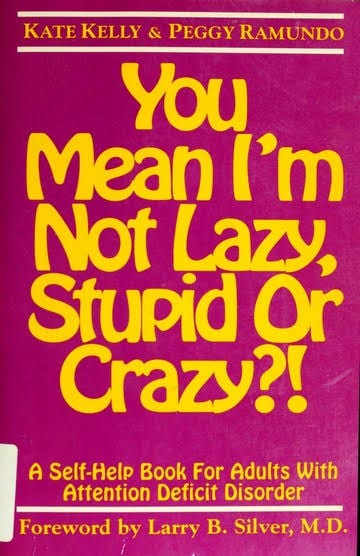
In 1993, Kate Kelly, a mental health nurse, and Peggy Ramundo, an ADHD coach, published You Mean I’m Not Lazy, Stupid, or Crazy?, and Thom Hartmann introduced his theory of the hunter in a farmer’s world in Attention Deficit Disorder: A Different Perception. The next year, psychiatrists Ed Hallowell and John Ratey put out quite possibly the most famous adult ADHD book of all time, Driven to Distraction, which sold millions of copies and is widely credited with popularizing the condition.
Adderall hit the market in 1996, the same year Keith Conners (who developed the Conners Scale for ADHD) founded the Journal of Attention Disorders. Thanks to some tweaks that the US government made to drug advertising laws in the early 90’s, pharma companies started to flood the media with stimulant ads. They funded conferences, distributed informational booklets to doctors’ offices that explained how to recognize adult ADHD, and paid celebrities like Ty Pennington to go on TV and talk about their own experiences with ADHD.10
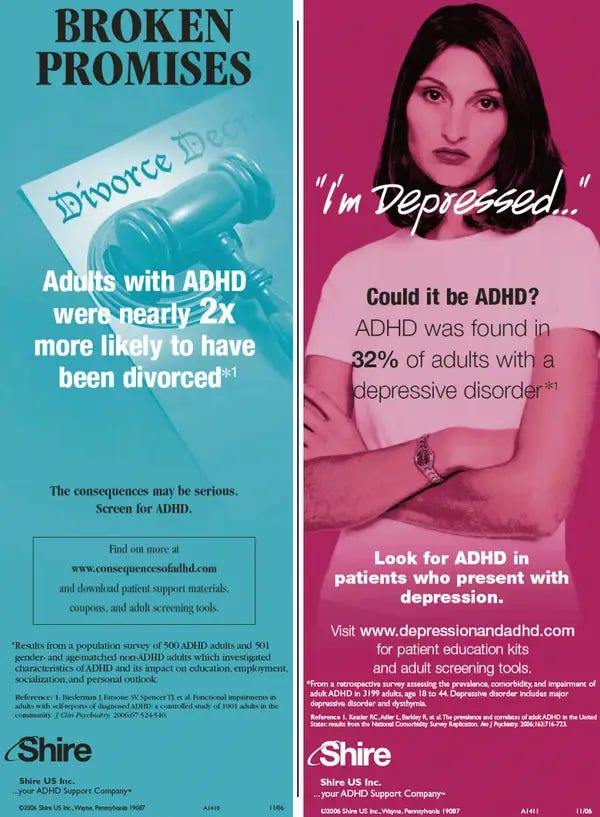
The superpower narrative of ADHD, which DeBoer reserves much ire for (as do I!), has come from, again, white professionals with high-profile connections: people like the psychiatrist Ed Hallowell, the angel investor Peter Shankman, and of course, the celebrity Paris Hilton.11
All of this happened in the context of an accelerating economy, one where work was getting more cognitively demanding, worker protections were being hollowed out, university admissions became cut-throat competitive, and media was being streamed through our hands into our eyeballs in a personal orgy of constant overstimulation.12
So yes, adult ADHD exploded, but it had little to do with social media influencers, who appeared pretty late in the game. The medical establishment redefined ADHD before the patient communities coalesced online — they were just responding to what the professionals told them, through the media and in their doctors’ offices, and the limits of their bodies in the face of a rapidly changing economy.
As for autism — it did not begin as a ‘hardscrabble diagnostic neighborhood’, as DeBoer describes it. Robert Chapman has said that migration would be a better metaphor than gentrification, because the diagnosis was originally constructed around white middle class boys, and in the 21st century, it has seen an influx of women, people of color, and queer and trans people, ‘for the recognition and protections it offers.’
Jordynn Jack, in her book Autism and Gender, writes that Kanner and Asperger both initially set autistic kids apart from the ‘feebleminded’, who were often depicted as ‘poverty-stricken ragamuffins’. The autistics, in contrast, were ‘innocent, middle-class boys, the scions of intelligent, professional fathers and cold, obsessive mothers.’ She writes:
“Take, for instance, Kanner’s patient Frederick, born in 1936, who grew up with his mother, a college graduate and former director of secretarial studies for a girl’s school, and his father, also a college graduate and a plant pathologist. His family tree featured a medical missionary, a best-selling author, a singer, a writer for adventure magazines, and a painter. Frederick was one of the eleven patients Kanner originally identified in 1943, and this pedigree (and that of Kanner’s other exemplars) led Kanner to note that perhaps there was something particular about autism that targeted the middle class.”13
The historian Mitzi Waltz concurs:
“Perhaps the most pernicious effect of the autism narrative put forth by Kanner and other early investigators about autism was its construction as a syndrome primarily affecting children from upper-class, high-achieving, and often Jewish families.”14
The figure of the cold, emotionally distant Refrigerator Mother, which was thought to cause autism for a time, was always white and affluent:
“For example, in the documentary film Refrigerator Mothers, Dorothy Groomer, an African-American mother, discusses her attempts to get appropriate help for her toddler son in the 1970s. She found out about autism with the help of a friendly librarian, but when she showed a diagnostic team that her son fit the criteria, she was rebuffed. ‘We did not fit the classic mould for autism, which is: white, upper middle class, and very, very bright.’”15
To be fair, DeBoer does point out that diagnoses have been on the rise among children of color in recent years, but he blows straight past this stat and continues on with his erroneous gentrification metaphor regardless.
This is a problem when we consider his conclusion: that doctors need to ‘say no’ more when patients come seeking diagnoses. Doctors do say no, a lot actually, but it’s mostly to people who are not white, and not men.16
The Fear of Fakers
All In Your Head is a good example of something I touched on recently, ‘the fear of the disability con’. DeBoer’s intentions are good — he wants to help those who most need it — but unfortunately, spreading this particular fear is likely to make things worse for all disabled people.
Studies have shown that this fear of disability fakery is widespread (much of it thanks to the media), but people far overestimate how much it actually happens.
Interestingly, according to Doron Dorfman, both disabled and non-disabled people show similar levels of suspicion, and non-disabled people with a disabled friend or family member actually show more suspicion than others (which could explain some parent advocates’ animosity to self-advocates they suspect of not being really autistic — it’s a protective urge.) Disabled people who have been victims of suspicion also tend to show more suspicion toward others.
DeBoer implies that this is all just part of the natural fact that resources are scarce, but Dorfman’s research found the opposite:
“Findings counterintuitively suggest that the scarcity of the desired public resources has no effect on the level of suspicion against potential abusers. Rather, it is the sense of deservingness (or lack thereof) in the eyes of others that drives suspicion.”
This explains why those of us whose disabilities are not immediately apparent get the brunt of this suspicion. But people with visible disabilities are also negatively affected by this — Dorfman found that many disabled people put off acquiring mobility devices or asking for accommodations they need because they are deterred by the fear of the disability con:
“..even people who have been disabled most of their lives remain reluctant to seek new accommodations. Terri, 63, who has been a wheelchair user since childhood due to juvenile rheumatoid arthritis, got her service dog only ‘six years ago, after I retired. I wish I’d had gotten one before I retired, but at that point I thought, ‘I’m doing fine; I don’t want to take it away from someone who may need it more than I do,’ and I shouldn’t have thought that; I should have gotten one much earlier.”
“Will, 41, who became quadriplegic a few years ago from a car accident, had a similar reaction about using a disabled parking permit: ‘I’d save it for people who, you know, really do need it . . . Today driving here in the van [I parked in the disabled parking spot, but], if I’m in my regular car and stuff, I try not to park in the handicapped spot or something, just ’cause I don’t really [need it]. You know, with my van, I kind of need it because of how the lift works, but if I don’t have to, I don’t.’”
So, this is another thing I agree with DeBoer about: ideas matter. They affect how we treat each other, and how we treat ourselves. They shape policy. And politically, this idea, the fear of people faking hardship for personal gain, usually leads to funding cuts and austerity. You can look at Reagan’s welfare cuts in the 80’s, based on the racist figure of the welfare queen, or more recently, the UK’s panic about overdiagnosis, which led to a fierce fight over welfare cuts.17
However, an independent report published last month could not confirm that overdiagnosis is happening at scale in the UK, instead arguing:
“The rise in mental health problems is real, is affecting everyday functioning and cannot be explained by greater awareness alone.”
Fear of the disability con has been used to justify cuts stateside recently, too, with the Trump administration proposing cuts for adult disabled people living at home with their impoverished families — the very autistic population DeBoer is concerned about. Ultimately, I do not think his argument is going to have the effect he intends, and I actually think it will harm the people he cares about most.
At the beginning I said DeBoer chose the wrong villain, and I want to be clear, I don’t mean that we should be fighting parents of autistic people instead. I have long been exasperated by the ‘autism wars’ online, and find much of it a distraction from the political work that needs to be done.18
What would actually help the people who need the most support? Housing. Money. Medicare for All — which, to his credit, DeBoer does bring up briefly. But I find it hard to see how we get there if we’re stuck fighting over who is autistic enough, or which words are okay to use, or who has the most functioning privilege19 — and especially if we further entrench the fear of the disability con with books like this.
If you’d like to peruse my previous hate-reads:


for more on this critique, see: Neurodiversity 2.0 by Hari Srinivisan, or this piece by Ginny Russell in The Transmitter
see Robert Chapman’s writing on neurodiversity-lite, Sami Schalk on the supercrip, and my own critiques of the superpower narrative here, here, and here, some of it 5 years old at this point!
see: The Autism Industrial Complex by Alicia Broderick, also, have you read Health Communism yet… :)
Jacqueline den Houting wrote this piece in 2019 breaking down all the misconceptions critics of neurodiversity make and it’s basically DeBoer’s greatest hits
I also agree with him that there are some particularly annoying, cancel-happy sadists on the neurodivergent internet, who spend far too much time concerned about policing word usage and shaming people, which is not politically strategic whatsoever, because they ultimately end up pushing people who they mostly agree with further to the right — but these types exist in all communities online, because the structure of the internet rewards such behavior, and I don’t think it’s fair to judge an entire group by their worst-behaving members.
see: this study where some neurodiversity studies researchers plotted their beliefs on a chart and found that they do not all agree about what the movement is and what it should do
pedantic, I know, I can’t resist sometimes
“If the multiple causes of our children’s immune problems can be remedied, then the inflammation in our children’s brain is reduced. That’s when the blood flow to the areas of the brain that control speech, social skills, motor planning, and more improve. Improved blood flow means improved function. That’s when your kid has a chance.”
“For the skills that were especially hard for my son, we used primary reinforcers. Ryan’s deficits in the motor planning area like catching a ball, moving his game piece on the Sorry board, or riding a bike were huge. When we taught those skills, Ryan was rewarded with a Skittle or a French fry.” from Autism 101, Hinds
You can read the full story in Donvan and Zucker’s In a Different Key
Schwarz, ADHD Nation
I literally started working on a video essay about this months ago, but I got distracted and forgot to finish it, bc my ADHD is not a superpower
See the chapter on post-Fordism as a mass disabling event in Chapman’s Empire of Normality
actually quite a few of the parents of Kanner’s original 11 case studies were psychiatrists, fun fact
If you want to read one book on autism history, Waltz’s Autism: A Social and Medical History is a good one!
Waltz again. You can watch this clip on youtube!
It’s not really possible to measure flat-out denial of diagnosis, because that’s not really recorded, but the pattern that shows up in research is delayed diagnosis or misdiagnosis, not overdiagnosis. bias against women and POC in medicine is well-documented in general, but as for autism and ADHD: this 2017 study found that the ratio of male to female in autism is more like 3:1 than 4:1, due to girls being missed; this 2024 study found that autistic women report way more prior diagnoses and misdiagnoses than men; this 2021 study found that autistic women were more likely to be misdiagnosed than men, often with borderline personality disorder; this 2025 study found that women and men with ADHD had similar symptoms and age of onset but women were diagnosed later, and by the time they were diagnosed, they showed ‘greater clinical severity’; in 2007, Black children were 2.6x less likely to be diagnosed with autism than white children, and they were often diagnosed with conduct disorders instead (although that gap has since closed, now they have higher autism prevalence); Black Americans are also more likely to be misdiagnosed with schizophrenia when they have depression, and there is historical precedence for this.
There is a very long history of this kind of political rhetoric in the UK being used to justify cuts — see the work of Frances Ryan and John Pring
I also, like, have an autism mom, lol. I wrote this piece a looong time ago, trying to understand where they’re coming from, and arguing for disabled solidarity over animosity.
honestly for someone who hates privilege discourse so much I think its so funny that this entire book is about how some people need to check their privilege..
Human beings have a desire/drive to categorize things. We feel comfortable when we can give a thing a label and put it into the appropriate box. Unfortunately, we don’t always agree on the label and the box. Hence why you get the “lumpers” and the “splitters”. The lumpers like to categorize “similar enough” things together, while the splitters are more strict when it comes to what makes things “the same”.
I wish that we could talk about mental and physical health disorders and illnesses and disabilities from the perspective of “what are your support needs, and how can we support you?”. Pitting one autistic against another autistic to discover or label who is “actually autistic” doesn’t help either person from getting the support they need.
This is so good. You are far more generous than I would have been.